
A few weeks ago I attended the first night of the Great Outdoors Comedy Festival (a great emerging local institution) with my wife and some friends, where we saw Robby Hoffman, Jordan Jensen, Pete Davidson, and Aziz Ansari perform. Their styles and performances were quite varied, but they all shared a throughline: each comedian at one point talked about how shitty Edmonton is.
It was pretty much all funny and delivered in a good-natured way. I was simply struck by a couple of things: (1) that when a bunch of performers from different places come here to perform, the most salient thing about Edmonton they can all agree on is how shitty it is, and (2) it was funny, and everyone laughed, because we all accepted it as to some extent true.
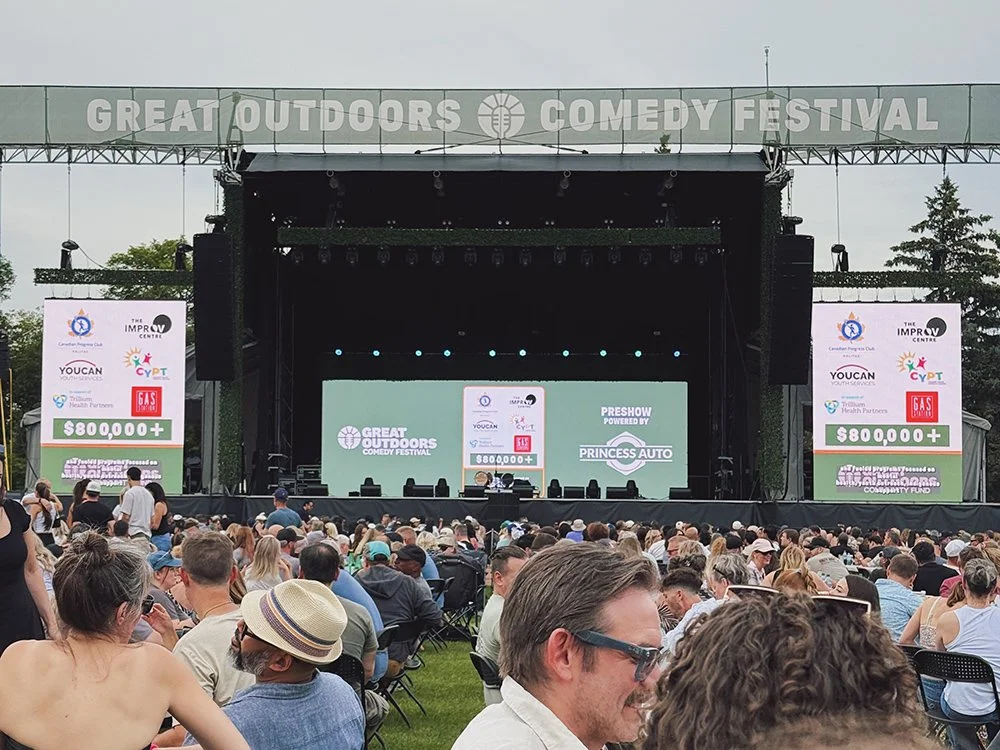
View from which I watched our fair city ruthlessly mocked
I was thinking about this over the following weeks as hospitality businesses downtown were closing seemingly by the hour, the state of downtown surely being a major contributor to Edmonton’s negative image. My hope is that this wave of closures motivates some action, because I personally think it’s a huge problem that (1) the overwhelming opinion held by people who know anything about Edmonton (including many people who live here) is so negative, and (2) this opinion is not without some basis in reality.
A shabby city is like a regressive tax paid every day by the people who don’t have the means to avoid it. If you have resources, you can build a nice house with a nice yard in a nice neighbourhood (behaviour I’d encourage, please contact me if you’re interested in doing this), maybe work from home, and escape to Palm Springs or Arizona in February. If you don’t, you just kind of deal directly with our shared public realm in whatever state it happens to be in.
The negative external and self-perception that flows from this shabbiness perpetuates it. It leads us to see our circumstances like the weather, inherent and immutable, the product of forces outside of our control (the province, the climate, the culture, the economy, etc.), and therefore not worth doing anything about. Our unpretentious and pragmatic culture, which I largely admire, may be another contributor to the bizarre complacency on these issues, insofar as it tends to view the idea of improving the aesthetic quality of the city as frivolous or wasteful.
I think both ideas are flatly wrong. Making downtown (and the city as a whole) more pleasant and beautiful is something that is within our control and worth doing.
What to do (high-level)
Focus. We’ve collectively invested a lot of money downtown, but the area we call “downtown” is huge and the investments have been scattershot. An urban park here, an entertainment district there, a Quarters here, a streetscape renewal there, all in some ways representative of progress but as of yet not amounting to a single thriving urban district or neighbourhood.
Urban development is highly non-linear and doesn’t reward this approach. A single great cluster of blocks is infinitely better than 10 or 20 middling ones. It’s like the difference between a bunch of small, independent sparks smoldering alone and a single, self-sustaining fire. I’d suggest drawing a box bounded by 106 Street to the west, 100 Street to the east, 104 Ave to the north and Jasper Ave to the south and ruthlessly focusing resources, effort, and attention within it until this relatively small area, at least, is thriving.
Many of the other ideas that I’m proposing here and others have proposed elsewhere become much more manageable and achievable if envisioned (at least initially) for this small area versus the entirety of “downtown”.
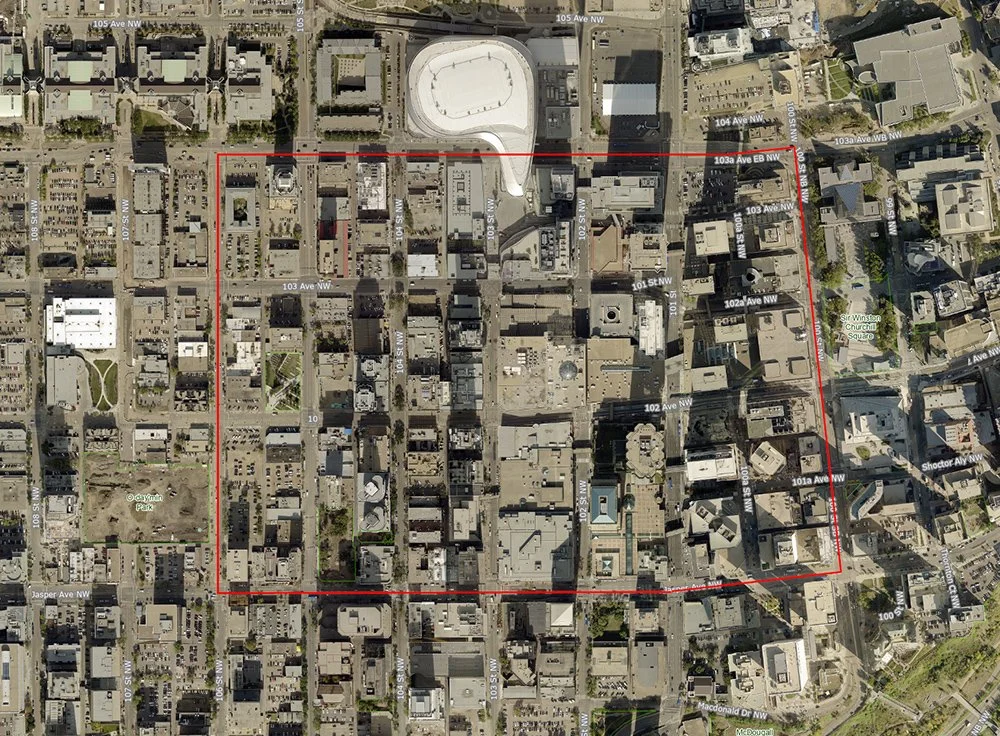
Proposed area of focus downtown
Perception and reality. Urban development is on some level a massive coordination problem. Successful development relies on a large number of people within (and without) a city having a shared understanding of what parts of the city are to be used for which purposes. This shared understanding informs, for example, decisions about where people might patronize certain types of business, or, on the other hand, invest money to serve a certain kind of customer.
Given this, I think that when considering various urban development measures, we need to be extremely mindful of the fact that the shift in perception they create is at least as important as their effect on physical reality. Particularly with regard to downtown, measures are only useful insofar as they help to sustainably shift the shared understanding of downtown away from its current state and toward it being a vital, thriving, safe, and beautiful part of the city that people want to be in.
O-day’min Park is one example of this. It has clearly served a signalling function that has led to a significant amount of private sector development on its perimeter. The current on-the-ground reality immediately surrounding the park remains mostly desolate, but it’s shifting, because the City’s investment in and development of the park sent a message about where that particular part of the city was headed that allowed private actors to coordinate.
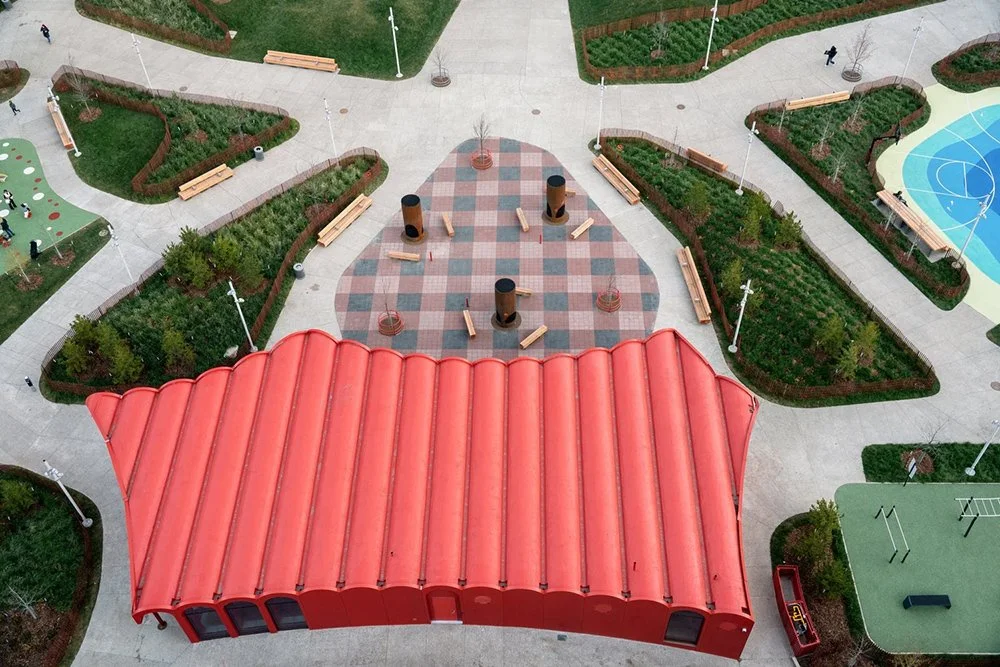
O-day’min Park Pavilion. Image courtesy of gh3.
Another is the much-discussed idea of free parking. I think the idea that it’s difficult to find parking downtown is absurd—I wonder honestly if there is a city bigger than a million people anywhere in the world that has more parking spaces available downtown than Edmonton, Alberta. So while in a practical sense I don’t think free parking has a lot of merit, in a narrative sense I think it has a lot of potential. For minimal expense, it would send a clear message that the City is serious about getting people downtown, and remove a perceived obstacle for a lot of people. (It would also help to remedy the terrible decision to remove all of the ePark machines, thus restoring the ability of people who don’t have the desire, means, or ability to operate a cellphone to park their cars).
What to do (obvious)
Construction. This issue has been discussed extensively, and I don’t have a lot to add. Construction is good—in the long run, the Valley Line expansion, streetscape improvements, O-day’min park, MacEwan expansion, etc. are going to benefit downtown and the city as a whole—but, as many have observed, these projects need to be planned in a way that allows for the sustained prosperity of the businesses in their surroundings, with businesses possibly supported during construction (as has been the practice in Montreal since 2018).
Worth adding is that even after years of discussion and debate the City still seems to have failed to figure out a workable system for OSCAM permits. Allowing contractors to close irrationally large stretches of road for very long periods of time, sometimes seemingly at random, surely has not helped the issue of downtown access.
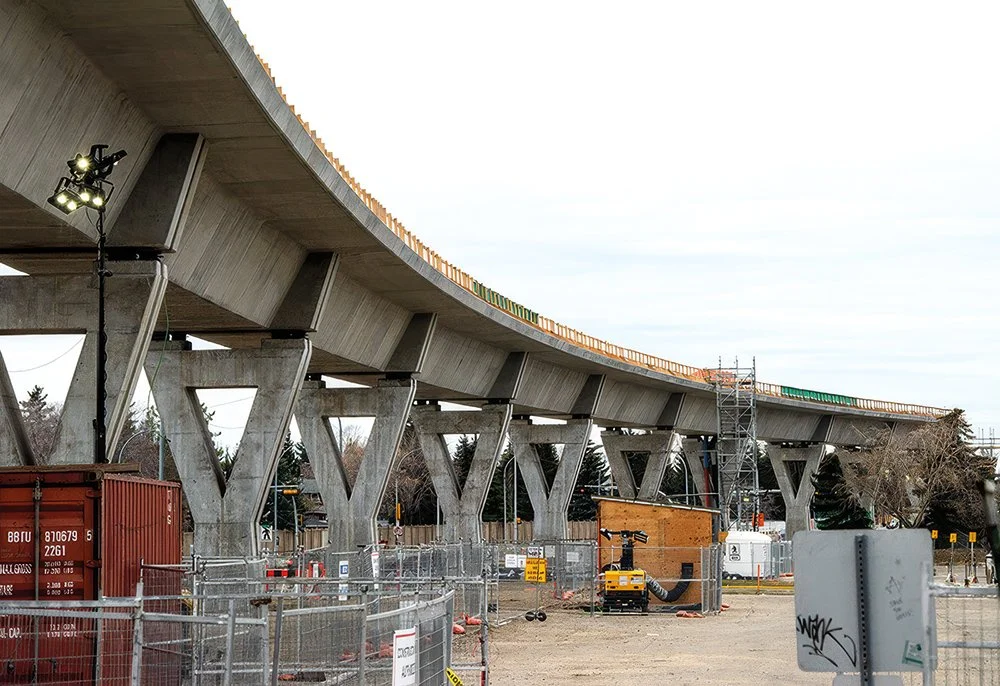
LRT Construction. Sovid Media.
Disorder. Similar to the above, this is an extremely well-discussed issue, and one far outside the realm of my expertise, but it bears mentioning due to its critical importance.
I’ll limit my contribution to the observation that we need to consider the timescales at play. I’m a firm believer that the most important part of the solution to the disorder downtown is building the physical and social infrastructure necessary to house and support the homeless population. While Edmonton has made exemplary progress in this regard, which is something we should be proud of and should strive to continue, this is the work of a generation.
The problem is that this generational answer seems to have become a way of declining to give a present-tense one. If the only answer we have will take 20 years to implement, it means that in the meantime we do nothing. This inaction has costs, which again fall mainly on the people without the means to avoid them—the person taking transit to an early shift, the student who can’t afford to drive, the shop owner with no other location.
My sense is that a shorter-term solution would involve doing a better job of enforcing laws regarding vandalism, public drug consumption, etc., while ensuring that we’re policing behaviour, not people. No small task, but one possibly made easier by focusing these efforts, at least initially, in a smaller area.
What to do (incentives)
Subsidy. While there has been a lot of development in Edmonton over the last few years, little of it has found its way downtown. The very simple reason for this is of course that it is much more profitable to develop housing, commercial space, etc. or open retail or hospitality businesses on the fringes of the city. When downtown eventually reaches a critical mass, and is perceived as a desirable place to live, eat, go out, etc., investing in these things downtown will become profitable and economically self-sustaining. In the meantime, we need to use subsidy to close the gap. We already do this in various forms, but I’d propose focusing our subsidy in a few specific areas:
Storefront rent subsidies. The businesses that occupy the storefronts create a reason for people to come downtown and the activity that enhances safety. Perhaps above all, they are also perceptually very important—a shorthand metric by which someone passing through downtown (or any neighbourhood) gauges its vitality, safety, and desirability. Via the Storefront Improvement Grants, we currently subsidize the appearance of storefronts in various parts of the city; we just don’t subsidize whether anyone is in them. The devil is very much in the details, but examples like Vacant to Vibrant in San Francisco, the Danforth East Pop-Up Project in Toronto, or Seattle Restored suggest that when properly designed and limited in scale, programs like this can be successful, and meaningfully improve storefronts without simply subsidizing landlords.
Residential unit construction subsidies. Another point of near-universal agreement is that we need more residential units downtown. The most direct way to achieve this initially would be a per-unit subsidy. Although I’m not an expert on this, I’m not convinced that we should limit unit subsidies to office-to-residential conversions (as some in the development industry are asking for). My sense would be to set a subsidy at a sufficiently high level to create development, limit it to a target priority area like the one described above, and let the market sort out whether conversions make sense or not. We currently do have a residential unit subsidy program in the form of the Attainable Housing Incentive Program, but it’s limited to housing meeting affordability criteria, and the subsidy is based on tax uplift vs. just a straight per-unit subsidy.
As I advocated in my post on the BMO site, I’d also be in favour of the city acquiring strategic pieces of land then selling them to developers for preferential rates in exchange for setting some of the parameters for their development.
Danforth East storefronts
Tax Reform. Our current regime assesses property taxes on the basis of the overall value of a property—that is, the sum of the value of a piece of land and the improvements (e.g. buildings) that have been made to it. The increased taxes that would result from making improvements create a clear disincentive to do so. Many urbanists have therefore long been advocates of land value taxation, which levies tax on the basis of only the underlying land value. In such a regime, the owner of a vacant lot would pay more or less the same amount of taxes as the owner of a tower sitting on an equally-sized lot adjacent to it. The tax burden would shift toward vacant land, thus creating an incentive to develop it.
There are several barriers to implementing such a regime in Edmonton. The Municipal Government Act is one of them, although a Depreciation-Assisted Land Value Tax (in which a pure land-value-tax is approximated by simply exempting the improvement value of new construction for the first half of its projected life) could be a workaround. Another is scale. Upending the property tax regime of an entire city would obviously be quite fraught, but it’s easier to imagine implementing it on the scale of a 6 by 3 block rectangle downtown.
Also worth investigating is whether or not property taxes on commercial properties are levied on an as-occupied or occupied-to-market basis, the former producing a marginal incentive for vacancy. Both of these ideas address the same basic problem: holding under-utilized land downtown is too cheap.
Conclusion
While some of what I’ve suggested here could take effect on a relatively short timescale, much of it is difficult and will take a long time to implement. The key is to start, ideally on several initiatives in parallel, with the hope that successes on shorter-term initiatives can create momentum, support, and buy-in for the actions that will take longer to unfold. Some of it won’t work, but that’s the cost of trying anything. And, above all, focus. Pick the zone I’m suggesting, or a different one, even a block, and make that great. Further success will flow from there.
The persistence of downtown’s struggles suggests that the problem is difficult and structural, but that shouldn’t dissuade us from action. An improved downtown benefits all of us, particularly those least able to insulate themselves from its current problems. I invite you to dream with me of a beautiful future when American comedians visiting us open their shows with a joke about our accent or driving.